Automatic Sliding Gate Installation Cost California
By the Garage Home Editorial Team — reviewed for accuracy. Last updated October 2026. This article is for informational purposes and reflects typical market pricing; obtain local quotes for your specific project.
An automatic sliding gate is the moment a driveway becomes an entrance: steel track, cantilevered panel, motor that pulls two hundred kilograms of gate on a signal. In California — hills, long driveways, and EV-charging security concerns — it’s also one of the most variable quotes in home improvement, because ‘sliding gate’ spans kit-grade aluminum through engineered steel.
This guide prices 2026 California sliding gate installation honestly: gate fabrication tiers, the motor and safety hardware that carries the compliance load, and the drainage and track details that decide whether a gate glides for a decade or binds in year three.
Automatic Sliding Gate Installation — At a Glance for US
A professionally installed automatic sliding gate in California runs $3,000–$12,000 — gate fabrication, track or cantilever hardware, UL325-compliant motor with safety sensors, and concrete work. Aluminum kit systems start the range; engineered steel with smart access control reaches the top. The motor is 15–20% of the price; the safety hardware around it is what the inspection actually reads. This figure is a realistic planning number for the United States in 2026, not a marketing low-ball.
| Line Item | Typical Range (USD) | What Drives It |
|---|---|---|
| Gate fabrication (aluminum, per 4 m gate) | $1,800–$4,000 | Frame, cladding, welding, finish |
| Gate fabrication (steel, per 4 m gate) | $3,500–$7,000 | Heavier, more durable, more finish work |
| Track/cantilever hardware + rollers | $600–$1,800 | V-groove track or cantilever system |
| Motor + UL325 safety package | $900–$2,500 | Inground or post-mount with photo-eyes |
| Concrete pad/footings + track foundation | $800–$2,500 | The line that prevents future binding |
| Access control (keypad, remote, smartphone) | $250–$1,500 | Keypad standard; smart systems higher |
Understanding Automatic Sliding Gate Installation
Sliding gates are engineering products: a 4-metre gate panel weighing 150–400 kg, riding on rollers along a track or hung on a cantilever carriage, driven by a motor sized to the gate’s mass with safety sensors that stop the panel before it hits anything the law cares about. The UL325 standard (the US gate-safety code) requires photo-eyes and entrapment protection — and California installers are inspected on it.
Track versus cantilever is the hidden decision. Track gates run a ground rail that must stay clean — leaves, gravel and LA hillside debris bind them. Cantilever gates hang on carriages above a concrete beam: no ground track, less maintenance, more steel. California’s fire-code access requirements (gates on fire-department access routes need emergency override hardware) add a specific compliance line urban quotes must carry.
What Moves the Price Up or Down
The $3,000-to-$12,000 spread decomposes:
| Factor | Cost Impact | Detail |
|---|---|---|
| Aluminum frame vs steel fabrication | ×2 | Steel is heavier engineering at every line |
| Track vs cantilever system | +800–2000 | Cantilever wins on debris-prone driveways |
| Gate width 3 m → 6 m | +40–100% | Panel mass and motor class both climb |
| Smart access (app, intercom, camera) | +400–1500 | Convenience tier, not compliance tier |
| Slope and drainage engineering | +500–2000 | Track-level precision on contour |
| Fire-access override hardware (CA) | +200–600 | Required on FD-access routes |
Sliding Gate Tiers
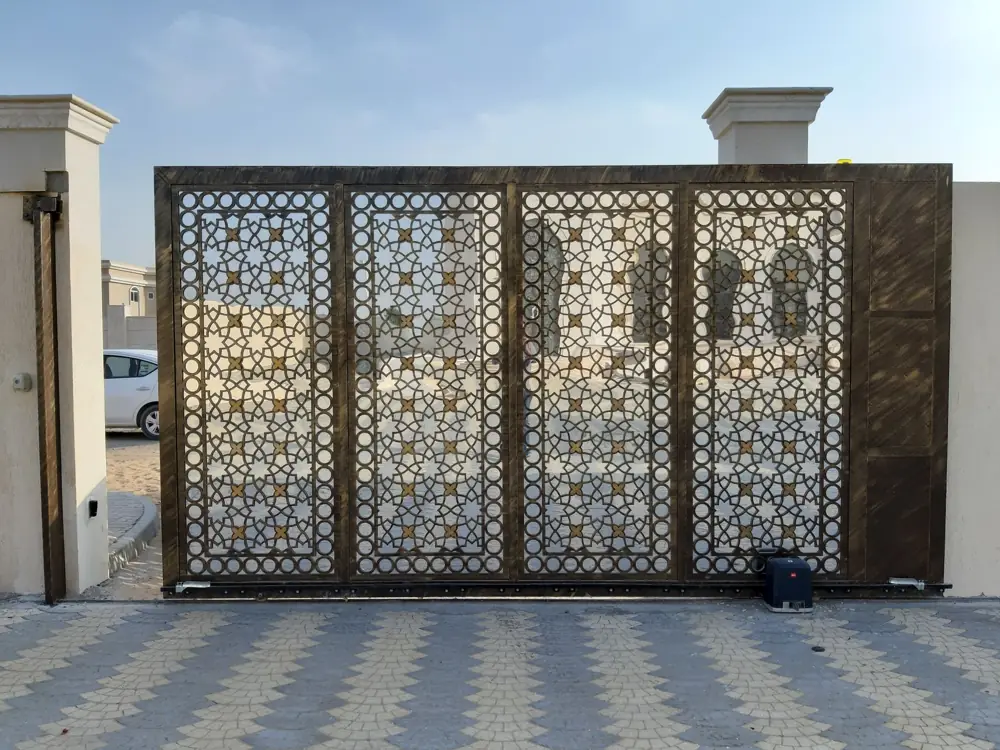
Three tiers with distinct products:
| Option | Description | Best For | Cost Level |
|---|---|---|---|
| Aluminum kit gate + basic motor | Pre-fabricated panels, post motor, keypad | Flat driveways, budget automation | Low ($3,000–5,500) |
| Custom aluminum, cantilever, smart access | Engineered lightweight with modern controls | Hillside homes, EV security, design-sensitive fronts | Mid ($5,500–8,500) |
| Engineered steel, cantilever, full package | Heavy steel, commercial-grade motor, intercom | Estates, long driveways, security-first | High ($8,500–12,000+) |
The middle tier is where California driveways land: cantilever for the debris-free operation, aluminum for the motor budget, smart access because the phone in your pocket is the remote that never gets lost.
Three Realistic Project Scenarios
Budget — 3.5 m aluminum kit, flat drive — $3,200–$4,800
Straight run, keypad entry, basic photo-eyes.
- Kit gate + track + basic motor — $2,200–$3,200
- Concrete and installation — $1,000–$1,600
Why this matters: kit systems on flat driveways are the honest entry — the automation works from day one at DIY-adjacent pricing.
Mid — 4 m cantilever with smart access — $6,200–$8,200
Hillside lot, debris-prone drive, app control.
- Custom aluminum cantilever gate — $3,200–$4,500
- Motor + safety + smart package — $1,600–$2,400
- Concrete beam and install — $1,400–$1,800
Why this matters: cantilever + smart is the California default now — no track to clean, no remote to lose, one intercom answer for deliveries.
Premium — 5 m steel estate gate — $9,500–$12,000
Long driveway, security-first, full intercom.
- Engineered steel fabrication — $5,000–$6,500
- Commercial motor + full safety suite — $2,200–$3,200
- Foundations, access, fire-override — $2,300–$3,200
Why this matters: steel estate gates are once-per-generation purchases — the engineering and motor class carry two decades of daily cycles.
The tiers are mass and engineering: aluminum answers most homes, steel answers estates, and the safety/motor package is a fixed compliance floor under both.
Sample Budget Breakdown
The table below shows how a typical mid-range budget for automatic sliding gate installation distributes across trades, materials and compliance in the United States. Adjust the percentages to your own scope before using it as a savings target.
| Category | Estimated Amount | Explanation | Optimization Tip |
|---|---|---|---|
| Gate fabrication | $2,200–$6,500 | Material and engineering tier | Match motor class to gate mass — undersized motors fail first |
| Motor, safety and access | $1,600–$3,200 | UL325 compliance + convenience | Never substitute safety hardware — photo-eyes are the code and the liability line |
| Concrete and foundations | $1,400–$3,200 | Track beam or cantilever footing | Spend here — 90% of binding gates are foundation problems |
Every figure above is an indicative 2026 market range. Final quotes move with site conditions, contractor availability and the exact specification you lock in.
From Quote to Completion: the Typical Timeline
Most automatic sliding gate installation projects follow the same five-stage rhythm. Knowing the calendar before you sign prevents the two classic frustrations — feeling rushed into a deposit, and being surprised by a mid-project gap while materials arrive.
- Build: 2–5 days for a typical block — Posts concreted day one and left to cure, then panels, rails, gates and hardware — most residential fences finish inside a working week.
- Week 6–12: settlement checks — Posts that were slightly proud settle in the first months; a 90-day defect visit clause in the contract catches gate sag and loose fittings free of charge.
- Day 0–3: site walk and measure — The contractor walks the boundary, checks slope and access, locates services (dial-before-you-dig), and quotes per metre with gates and corners itemised.
- Week 1–2: approvals if needed — Front-boundary or pool fences go to council; boundary fences need the neighbour’s signed agreement under the relevant Fencing Act.
- Week 2–4: materials delivery — Standard palings and panels are stocked; Colorbond, composite and custom slats run 1–3 weeks from the distributor.
Smart Ways to Control the Budget
Cost control on automatic sliding gate installation is mostly about scope discipline and timing. These are the strategies that consistently deliver the largest savings:
Book in late autumn or winter
Fencing crews are quietest outside the spring renovation rush, and lead times drop from weeks to days.
Advantages:
- Directly reduces the controllable parts of the quote
- No impact on structural quality or compliance when scoped correctly
Disadvantages:
- Wet-ground conditions can slow drilling and add soil-stabilisation costs.
- Requires planning lead-time you may not have on urgent repairs
Keep the gate simple
A single standard pedestrian gate adds far less than double drive gates with automation; every hinge and automation component is a maintenance point.
Advantages:
- Directly reduces the controllable parts of the quote
- No impact on structural quality or compliance when scoped correctly
Disadvantages:
- Reduces convenience for wide access or parking inside the fence line.
- Requires planning lead-time you may not have on urgent repairs
Get quotes priced per metre, not per job
Linear-metre pricing makes quotes directly comparable and reveals who is padding the corner, gate and slope work.
Advantages:
- Directly reduces the controllable parts of the quote
- No impact on structural quality or compliance when scoped correctly
Disadvantages:
- Some contractors refuse to itemise, and per-metre rates rise sharply on sloped blocks.
- Requires planning lead-time you may not have on urgent repairs
Replace posts and rails at the same time
Old posts under new palings are the most common cause of early failure; renewing the frame while crews are mobilised adds little labour.
Advantages:
- Directly reduces the controllable parts of the quote
- No impact on structural quality or compliance when scoped correctly
Disadvantages:
- Adds 20–30% to a straightforward panel swap.
- Requires planning lead-time you may not have on urgent repairs
Permits, Rules and Safety
California gates carry real compliance lines:
- Retaining walls over about 0.6–1.0 m (varies by council) require engineering and a permit — especially when a fence sits on top of the wall.
- Heritage overlays and conservation zones can dictate materials, colours and even the style of palings — always check before ordering materials.
- Front-boundary fences commonly need council approval and height limits differ between states — 1.2 m at the front is a frequent maximum, with 1.8–2.1 m accepted for side and rear boundaries.
Maintenance and Long-Term Ownership Costs
The purchase price is only the first line of the budget. These recurring items are what automatic sliding gate installation owners in the United States actually spend money on:
| Task | Frequency | Typical Cost | Why It Matters |
|---|---|---|---|
| Touch up galvanised or Colorbond scratches | As soon as spotted | DIY ($20 kit) | Edge rust spreads under the coating once it takes hold; touch-up paint stops it cold. |
| Wash and inspect palings/panels | Yearly | DIY (free) | Dirt holds moisture against the surface; a quick wash slows rot and corrosion dramatically. |
| Retighten fittings and check posts for movement | Twice a year | DIY (free) | Gates and corner posts work loose first; early tightening prevents rail sag. |
| Re-oil or reseal timber | Every 2–3 years | DIY $3–$8 per m² | UV breaks down timber coatings; scheduled re-coating roughly doubles paling life. |
Sliding gates want scheduled attention: roller lubrication every 3–4 months, photo-eye cleaning (spider webs are the #1 false-trigger cause), gate-track sweeping on track systems, and motor battery replacement on schedule. A serviced gate runs 15–20 years; an ignored one binds within five.
Frequently Asked Questions
How long does an automatic gate last?
15–20 years for the mechanical system with service; motors 7–12 years. The gate panel itself often outlives two motor generations — budget on the electronics cycling, not the steel.
Can I automate an existing manual gate?
Sometimes — sliders on good tracks accept retro-motors ($1,500–$3,000). Swinging gates need hinge assessment first. The honest answer needs the gate in front of an installer; photos over the phone produce optimistic quotes.
What happens in a power outage?
Battery backup (standard on better motors) runs 10–50 cycles; manual release keys exist on all compliant systems. California fire-access rules require emergency override regardless of power on FD routes — verify your installer addressed it.
Are permits required in California?
Often yes for new gate openings — driveway-cut and sight-line permits in most municipalities, plus FD-access review on shared driveways. Installers handle the paperwork; timelines run 2–6 weeks.
Summary
Planning automatic sliding gate installation in the United States starts with an honest range — $3,000–$12,000 for the scenarios most homeowners actually build — then works backwards through gate mass, cantilever-versus-track engineering and safety compliance.
Budget $5,500–8,500 for the cantilever-aluminum tier California driveways deserve, fund the foundation properly, and clean the photo-eyes monthly — that trio is the whole ownership experience. Collect at least three itemised quotes, confirm the permit path before signing, and hold a 10–15% contingency for site surprises. Those three habits protect more budget than any product choice.
Related Fencing Guides
- Frameless Glass Pool Fencing Cost Per Meter Gold Coast
- Pool Compliant Fence Installation Cost Melbourne Australia
- Simtek Composite Fence vs Wood Fence Cost Utah
- Hardifence vs Colorbond Fence Cost Comparison Perth
- Aluminium Slat Fencing Cost Per Meter Brisbane
- Trex Composite Fencing Cost Per Linear Foot USA